System Architecture
MAD Platform
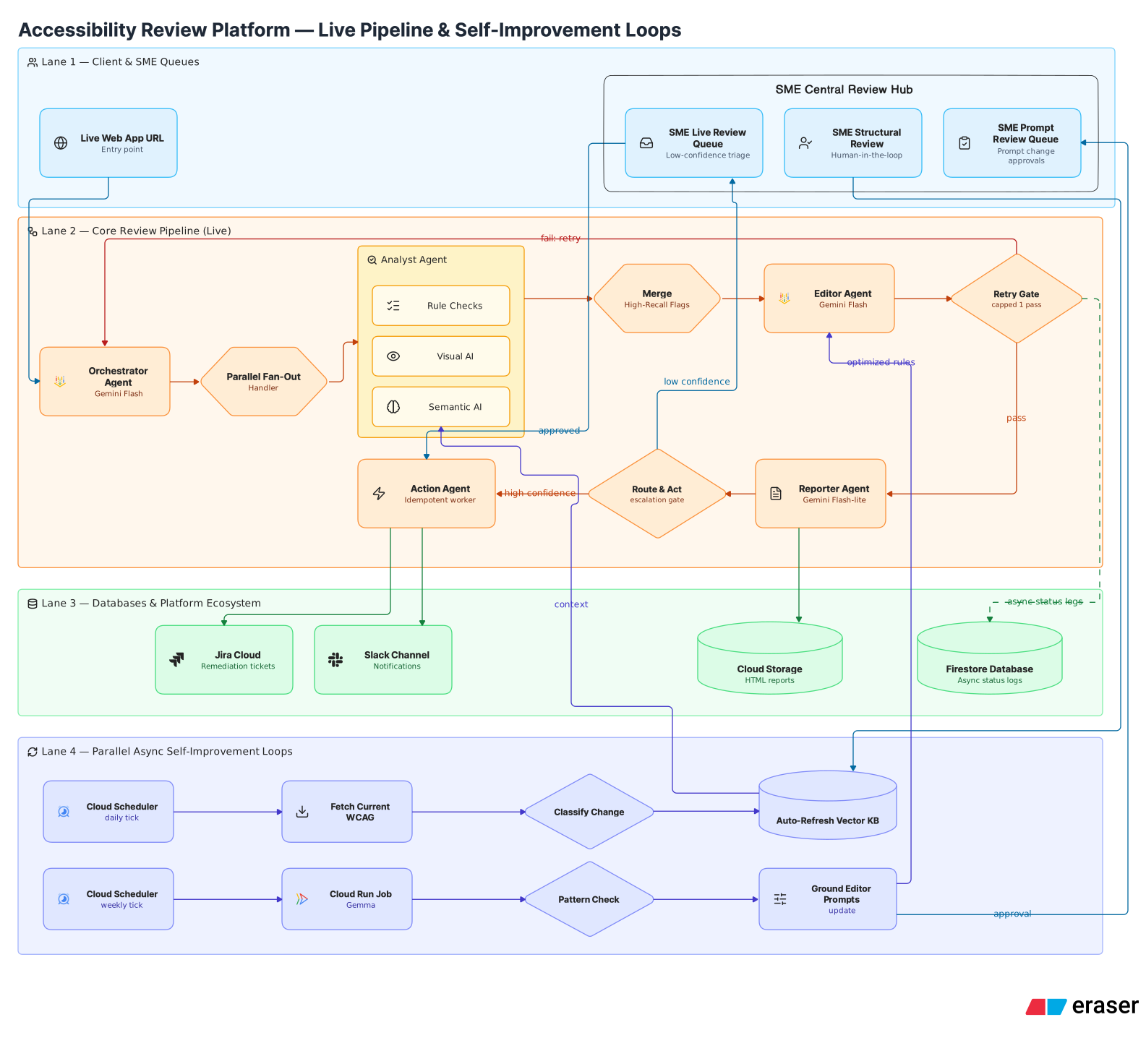
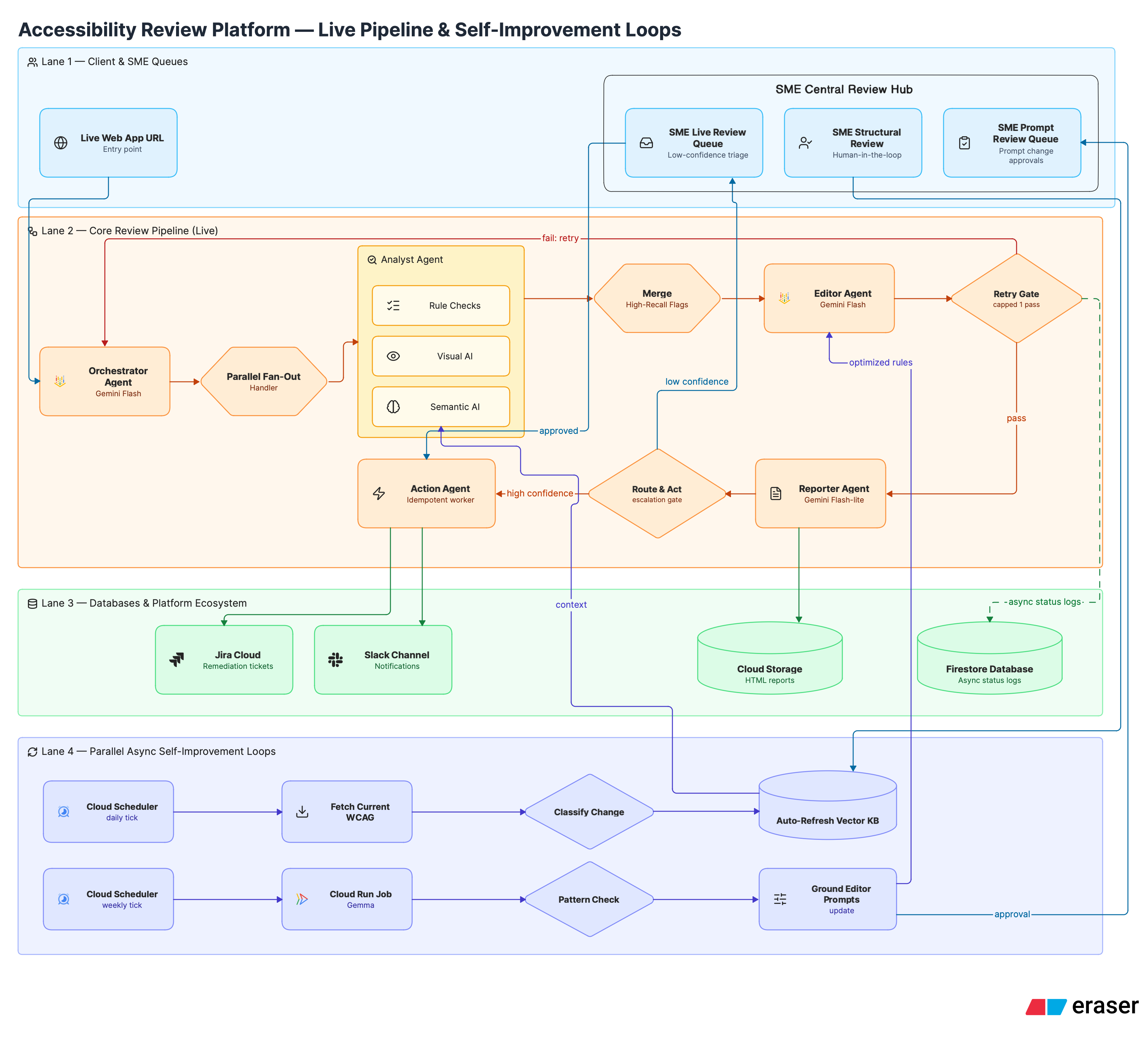
The full system in one picture. Walkthrough below.
Lane 1 — Client & SME queues
Lane 2 — Core review pipeline (live)
Lane 3 — Databases & platform ecosystem
Lane 4 — Parallel async self-improvement loops
How it works
The diagram above shows the mechanism; this section walks through why each piece exists.
Entry point
Web app: scan a site on demand
A URL submitted through the live front end kicks off a Review Cycle directly.
Live
Review Cycle
Sequential where order matters, parallel where it doesn't, dynamic delegation only at genuine judgment points.
Orchestrator: select pages
agent
Fetches the entry page, reads nav links, decides which pages carry real risk (forms, checkout, account flows): a bounded, justified subset, not exhaustive crawling.
Analyst: parallel per-page checks
tool + agent
Independent checks with no ordering dependency, run concurrently. Tuned high-recall: over-flagging is acceptable, missing a real violation is not.
Rule checkscontrast, alt text, headings, labels, ARIA, tab order
Visual AIscreenshot review: focus indicators, visual contrast
Semantic AIgrounded in the WCAG knowledge base below
Editor: independent verification
agent
Re-checks every flag against the underlying evidence. Dismisses false positives with a documented reason; assigns a validated confidence score to what survives.
Orchestrator: retry gate
agent
"Good enough, or one more pass?" Capped at exactly one retry: a bounded loop, not open-ended.
Reporter: rank and draft
agent
Ranks confirmed findings by real-world risk (WCAG level, litigation pattern frequency, user impact) and drafts the styled report against one fixed template.
Orchestrator: route and act
One escalation gate: low confidence or critical severity routes to a human; everything else is fully autonomous.
Action AgentFiles a real Jira ticket automatically. Idempotent: a retried step never double-files.
SME Central Review HubConfirm → files the ticket, live-updates the report the customer already has open. Dismiss → never becomes a ticket. The same hub also holds WCAG version-change and pattern-approval requests from the two loops below.
Both paths post to Slack: a real-time alert when something's escalated, a summary when the scan completes.
Memory: WCAG knowledge base
Grounds Analyst and Editor's citations against the real standard instead of the model's unaided claim, and stays current on its own.
Cloud Scheduler tick, daily
→
Fetch current WCAG version
→
Classify: minor or major?
→
Auto-refresh or escalate to SME Central Review Hub
Memory: Analyst/Editor's own judgment
Distinct from the knowledge base above: that loop keeps reference material current, this one tunes the pipeline's own behavior from its real history. A self-hosted Gemma, not Vertex AI: a background batch job with no live-request latency, exactly the workload Gemma's on-device design targets.
Editor's dismissal history
→
Weekly Scheduler tick
→
Cloud Run Job: self-hosted Gemma
→
Consistent pattern?
→
SME Central Review Hub
Confirmed → grounds Editor's prompt on every future scan.
Resumability
Every stage above checkpoints its completion to Firestore as it finishes. A restart, whether a crash or a redeploy, reads the last completed checkpoint and resumes from the next incomplete stage. It never blindly restarts from the top, and never assumes a stage completed just because the job record exists.
Google Cloud infrastructure
Cloud Run
2 scale-to-zero services + 1 Job, least-privilege per service
Google ADK
LlmAgent + Runner wraps every real-time Gemini call
Vertex AI · Gemini
Flash-lite for volume, Flash for judgment calls
Ollama · Gemma
Self-hosted on the pattern-miner Job, the one background call, not real-time
Firestore
Job checkpoints, findings, escalations, KB version, learned patterns
Cloud Storage
Generated HTML reports
Cloud Scheduler
WCAG freshness tick (daily), Gemma pattern-miner (weekly)
Secret Manager
Access codes, Jira + Slack credentials
Jira Cloud
Real ticket filing, not a mock sink in production
Slack
Real-time escalation alerts, scan-complete summaries
Playwright
Headless render, screenshot, computed styles